




US opens forced labour trade probe; Singapore among 60 economies named
Economies subject to the probe include China, Hong Kong, Indonesia, Japan, the Philippines, Singapore, South Korea, Taiwan, Thailand and Vietnam.
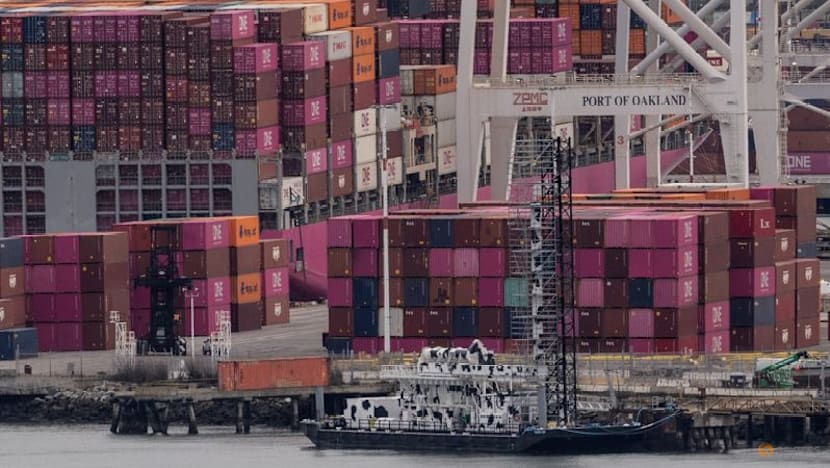
A cargo ship full of shipping containers is seen at the port of Oakland in Oakland, California, US, on Feb 3, 2025. (File photo: Reuters/Carlos Barria)
WASHINGTON: The US Trade Representative's office (USTR) said late on Thursday (Mar 12) it had initiated Section 301 unfair trade practices probes of 60 economies in relation to what it called failures to take action on forced labour.
President Donald Trump's administration has sought to rebuild tariff pressure on economies around the world after the US Supreme Court struck down his global tariffs as illegal on Feb 20.
"These investigations will determine whether foreign governments have taken sufficient steps to prohibit the importation of goods produced with forced labour and how the failure to eradicate these abhorrent practices impacts US workers and businesses," US Trade Representative Jamieson Greer said in a statement.
The list of 60 economies includes some major US trade partners and allies such as Australia, Canada, the EU, Britain, Israel, India, Qatar and Saudi Arabia. China and Russia are also on the list.





Other economies subject to the probe include Hong Kong, Indonesia, Japan, the Philippines, Singapore, South Korea, Taiwan, Thailand and Vietnam.
In a statement, Singapore's Ministry of Trade and Industry said it will engage its US counterpart on the Section 301 investigations.
Trump imposed a 10 per cent tariff for 150 days under Section 122 of the Trade Act of 1974 after the Supreme Court's ruling.
On Wednesday, his administration said it was launching trade investigations into excess industrial capacity in 16 major trading partners.
Greer said on Wednesday the "Section 301" unfair trade practices investigation could lead to new tariffs imposed against China, the European Union, India, Japan, South Korea and Mexico by this summer.
The US has already cracked down on solar panel imports and other goods from China's Xinjiang region under the Uyghur Forced Labor Protection Act signed into law by former President Joe Biden, and the probe could expand such actions to other countries.
Greer said he wanted other countries to enforce bans on goods produced with forced labour similar to those enshrined in a nearly century-old trade law.
The US alleges that Chinese authorities have established labour camps ​for ethnic Uyghur and other Muslim groups. Beijing denies allegations of abuse.
Greer said he hoped to conclude the Section 301 investigations, including proposed ​remedies, before Trump's temporary tariffs expire in July.
US TURNS TO MORE “DURABLE� TRADE TOOLS: ANALYST
Deborah Elms, head of trade policy at the Singapore-based philanthropic organisation Hinrich Foundation, said the Trump administration appears determined to ensure tariffs remain in place after the current 10 per cent temporary duties expire in July.
Countries such as Singapore would otherwise see tariffs fall to zero when the temporary measures lapse, she noted, something the US is unlikely to allow.
Section 301 is a US trade law that lets the government investigate other countries for unfair trade practices.
Elms said Washington is moving towards more “durable� legal authorities – such as Section 301 – that would be harder to overturn in court after Trump's earlier tariffs were struck down.
On the forced labour probe, Elms noted that being included does not mean a country is being accused of practising forced labour.
Instead, the US is examining whether governments are doing enough to prevent goods made with forced labour from entering or passing through their supply chains, she noted.
With 60 economies named, she described the investigation as “very expansive�.
“You have to show that not only are you not practising forced labour, that you are policing against incoming forced labour products, but also that your supply chains are clean and free of forced labour,� she told CNA’s Asia Now.
"This is going to be very challenging."
Elms suggested the two new probes may not be the last, and more could follow, potentially covering areas such as digital trade, environmental standards and pollution.
She added that the rapid shift in approach could also unsettle countries that had already negotiated trade arrangements with Washington, raising questions about the value of those agreements if tariff rules can be changed again.
"There's always a reluctance to be too vocal in front of Trump, because the consequences could be even more extreme if you raise issues," she added.
But if countries do not act, she warned, they could be stuck with high tariffs for years.


