




Why Bosch is expanding motorcycle safety technology
From anti-lock braking systems to stability control for smaller-capacity vehicles, Bosch is bringing advanced safety systems to a wider range of motorcycles.
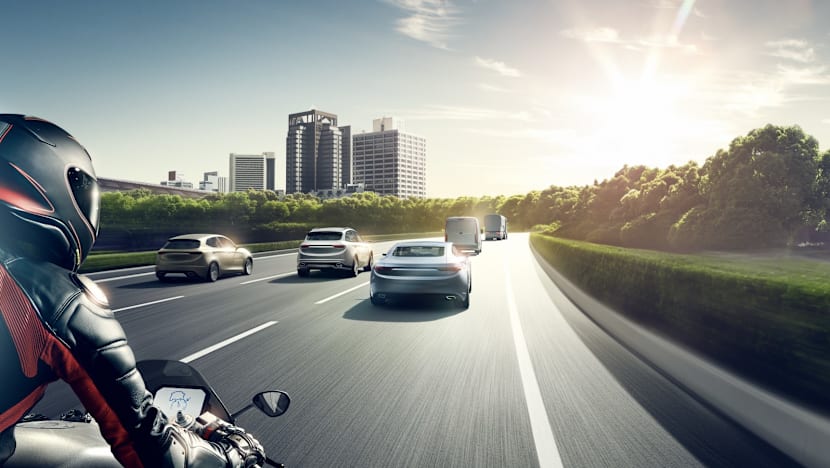
Bosch is rolling out advanced safety technology to more motorcycles, refining systems such as motorcycle stability control to fit smaller-capacity bikes. (Photos: Bosch)

This audio is generated by an AI tool.
If every motorcycle on the road were equipped with anti-lock braking systems (ABS), about a quarter of all motorcycle accidents could have been avoided, .
This is why global technology supplier Bosch has spent the past three decades developing safety systems for two-wheelers, long before such technologies became mainstream.
Since introducing its first motorcycle ABS in 1995, Bosch has continued refining its safety technologies, making them smaller, lighter and better suited to the demands of two-wheel riding. The first motorcycle equipped with Bosch ABS was the Kawasaki GPZ1100, marking a turning point in rider safety.
“The Bosch motorcycle ABS 10 light, the lightest variant today, is one-tenth the weight of the first-generation model,” said Mr Yusoof Mulla, head of engineering for Two-Wheeler and Powersports at Bosch Southeast Asia.





This push to broaden access has shaped Bosch’s work on motorcycle stability control (MSC). Introduced in 2013, MSC builds on ABS by using sensor data of vehicle dynamics to help riders maintain control even when navigating sharp turns or riding at an angle.
While systems such as the MSC have typically been reserved for larger motorcycles above 800cc, Bosch’s latest MSC has been adopted by an Indian manufacturer for a new model under 400cc. “We consider ourselves a pioneer of MSC systems for the sub-400cc vehicle segment,” said Mr Mulla.

ENHANCING MOTORCYCLE SAFETY IN THE REGION
Despite advances in technology, Southeast Asia still trails other regions in the adoption of motorcycle safety features. According to a 2023 global road safety report by World Health Organization, two- and three-wheeler accidents accounted for about 46 per cent of road traffic deaths in the region – well above the global average of 30 per cent.
From April 2027, Singapore will require all new motorcycles, including smaller models, to be equipped with ABS. Mr Mulla said Bosch is ready to support the shift with its full range of ABS systems, backed by more than 30 years of experience in the field.
“In Southeast Asia, two-wheeler safety systems such as ABS are typically available only on upper-end models, which indicates that advanced two-wheeler safety systems are not available to all riders,” he explained. “We hope to raise awareness of road safety and the benefits of safety technology.”
HOW ABS PROTECTS RIDERS
ABS prevents a motorcycle’s wheels from locking up during sudden or hard braking. Sensors on the wheels detect if a vehicle is about to lock up, and trigger the hydraulic system to rapidly modulate the brake pressure, releasing and applying it in milliseconds, to maintain traction. By maintaining traction, ABS allows riders to steer and stay upright, reducing the risk of dangerous skidding or a “stoppie”, where the rear wheel lifts. This is especially important on slippery roads, which are common during Southeast Asia’s monsoon seasons.
“Good riding skills are one of the key elements in avoiding road accidents, but even seasoned riders can face unpredictable emergency situations,” said Mr Mulla. “ABS is particularly effective in preventing accidents where a rider loses control and falls, often due to sudden braking or challenging road conditions such as gravel or wet surfaces.”
EXPANDING THE SCOPE OF MOTORCYCLE SAFETY
Bosch’s MSC marked a significant leap in motorcycle safety by extending stability control to cornering. In these situations, a loss of traction can lead to two common types of crashes.
In a low-side crash, a motorcycle loses tire grip and slides out in the direction of the turn, while in a high-side crash, the motorcycle first slides and then suddenly regains traction, violently throwing the rider off the bike. Using advanced sensor data on lean angles combined with ABS, MSC reduces the risk of both low-side and high-side crashes.
The next phase of advancement came with Bosch’s advanced rider assistance systems (ARAS), which come with functions such as adaptive cruise control designed for comfort and safety. More recently, Bosch has begun integrating cloud-based safety systems, including over-the-air updates that allow riders to add safety-related functions after purchase.
According to Bosch Accident Research, simulation studies show that under ideal conditions, radar-based rider assistance systems could help prevent one in six motorcycle accidents involving personal injury in Germany.
“Riders love the thrill and freedom of riding, and Bosch understands that,” said Mr Mulla. “Our engineers are riders too, so they know that safety should never take the fun out of motorcycling. That’s why Bosch designs safety systems that protect riders while keeping the riding experience just as exciting.”
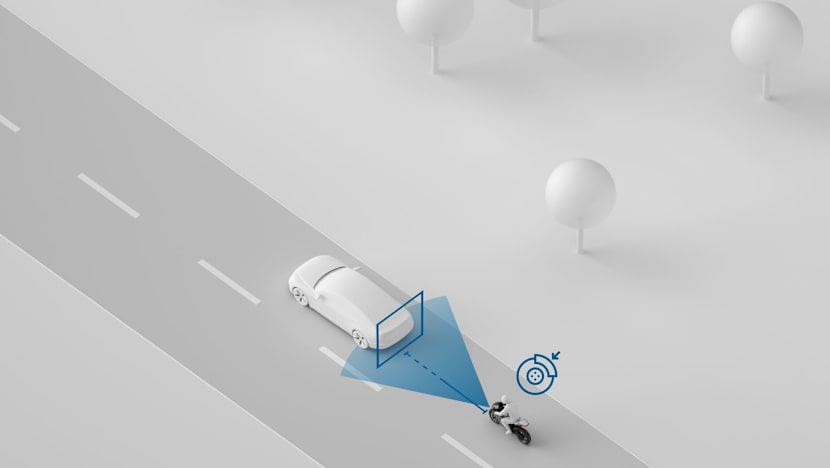
One example is riding distance assist (RDA), one of the latest ARAS functions. Mr Mulla explained: “It steps in only when the distance to a vehicle ahead becomes critically short. The system may gently reduce acceleration or apply light braking, but the rider can override it by adjusting the throttle.”
He added: “This design ensures the inherent freedom of motorcycling is maintained, while providing an invaluable, non-distracting layer of safety.”
THE ROAD AHEAD
Road and traffic conditions in Southeast Asia are unique, said Mr Mulla, pointing to congested urban streets and widespread use of lightweight motorcycles for daily transport. Bosch’s aim is to make motorcycle safety technology accessible to all riders by first advancing innovations on high-end motorcycles, then adapting them for smaller-capacity vehicles common across the region.
With several Southeast Asian governments promoting the use of electric two-wheelers through incentives for electric vehicles and phasing out of internal combustion engines, Bosch stands ready to provide safety technologies for electric two-wheelers.
“We already have the capability to integrate systems like ABS and MSC on electric two-wheelers, including those with regenerative braking, and we’re continuing to develop additional functions that enhance safety in everyday riding,” Mr Mulla shared.
He added: “Road and riding conditions across Southeast Asia vary a lot, and many of the challenges riders face every day are outside their control. Our focus is on understanding those real-world conditions and designing solutions that improve safety without changing the way people want to ride.”
Learn more about .


